
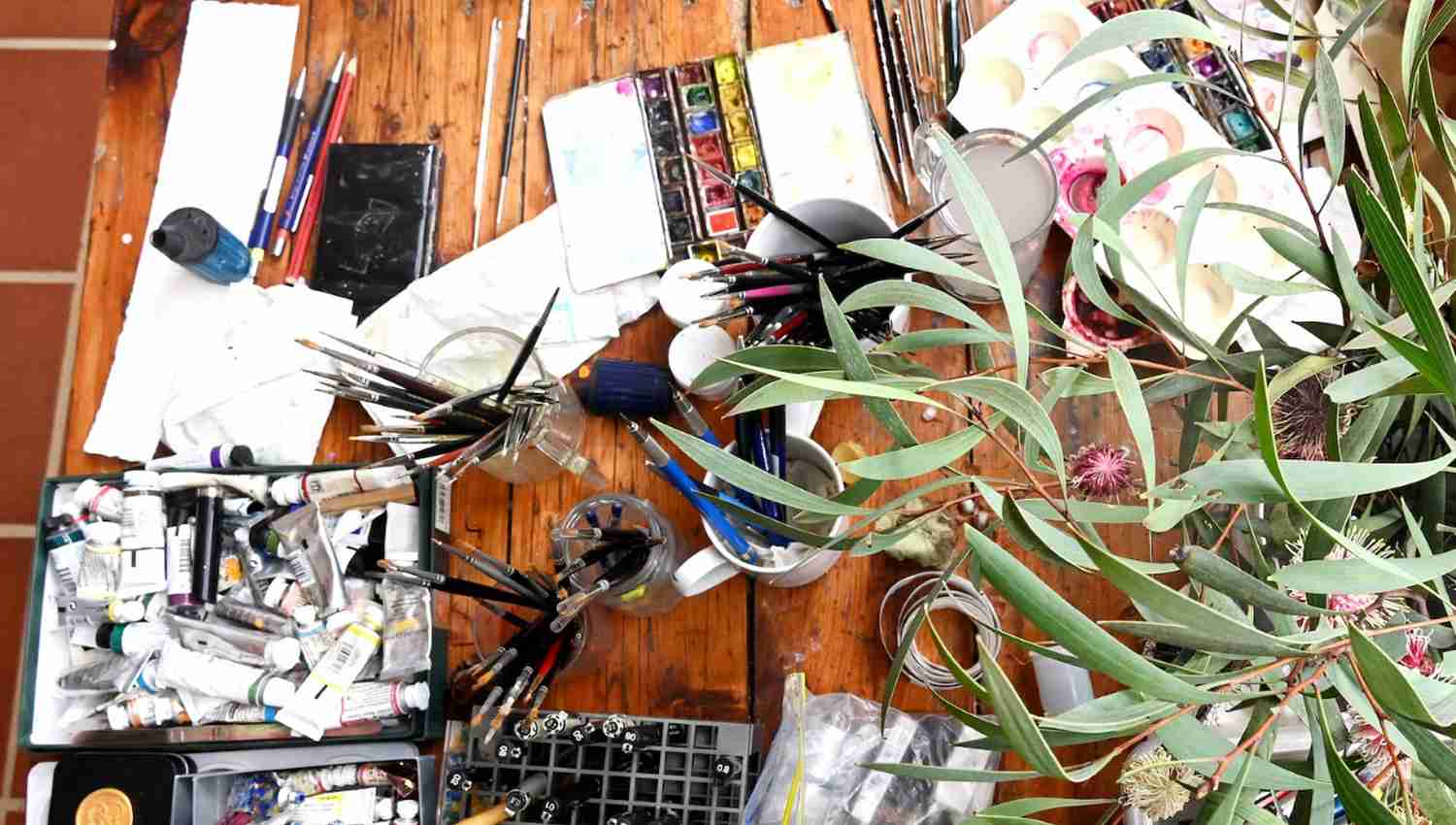

Stepping into Philippa Nikulinsky’s Perth studio feels like a peek inside her mind, from the desk overlooking the garden to the colourful illustrations on the walls and drawers filled with field notes. The 83-year-old self-taught artist traces her love of plants to growing up in Kalgoorlie, where harsh, dry country would occasionally erupt into a miracle of wildflowers. Using watercolours, she captures the curl of leaves and the tiny segments of flowers in exact detail, describing each work as a record of time and place rather than simply a pretty picture.
Her work belongs to a long legacy of botanical illustration by Australian women whose art has informed the understanding of the country’s flora, from identifying species to preserving references to landscapes that have since been altered or lost. Among the most influential of the past were sisters Harriet and Helena Scott, born in 1830 and 1832, who were among the earliest female commercial artists in the country.
Working from a young age with their father Alexander on a shared scientific notebook, the Sydney-born sisters collected moths and butterflies, built habitats for them and catalogued their features, later illustrating plates for their father’s book. An archivist at the Australian Museum, where their collection is held, said their plates were unusual for the time because they painted the full habitat around each specimen rather than the specimen alone. Unusually too, their father insisted they be credited at a period when women’s scientific contributions were routinely overlooked.
Their records still serve science today. Biologist Peggy Svoboda drew on Helena Scott’s 1862 species list for Ash Island, near Newcastle, while managing an ecological restoration project, calling it invaluable for understanding the landscape before it was modified. Another figure, Margaret Flockton, became the first scientific botanical illustrator at the Royal Botanic Gardens in Sydney, producing more than 2,000 illustrations alongside its director between 1901 and 1927, work that went largely unrecognised until recent decades.
The tradition continues with illustrators such as Lesley Elkan and Catherine Wardrop, who describe themselves as the visual communicators of science, working with botanists to highlight the features that distinguish one plant from its closest relative. They argue that nothing matches an illustrator’s ability to interpret a plant’s taxonomy, calling the results a translation that speaks to everyone, not only specialists. For Nikulinsky, the reward is personal: young visitors who tell her they took up botany because of her work, a response she says gives her goosebumps.