
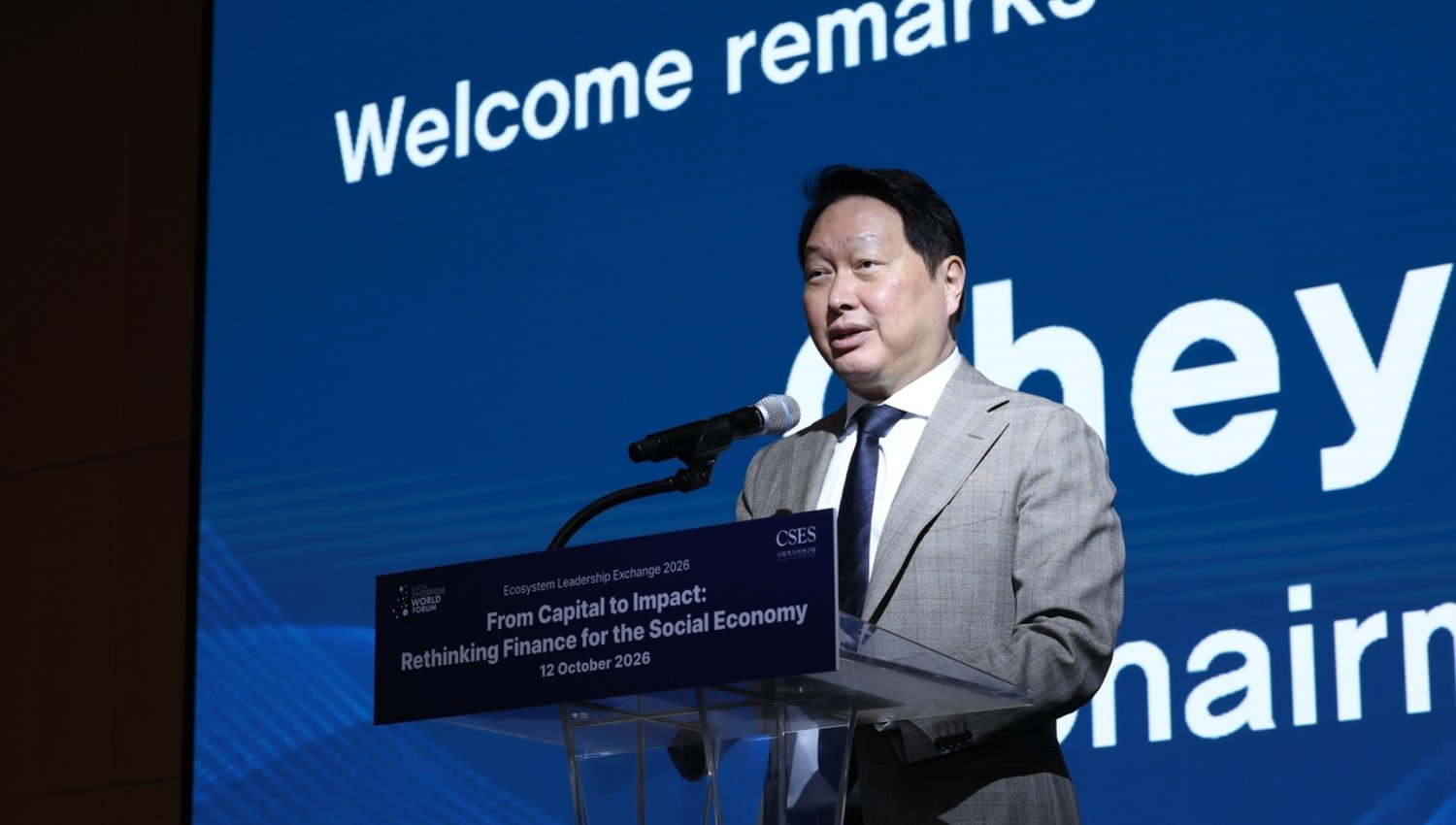

SK Group chairman Chey Tae-won has called for a form of capitalism in which companies are paid for the social value they create. He made the case at the Social Enterprise World Forum’s Ecosystem Leadership Exchange in Seoul, arguing that goodwill on its own will never raise enough money to tackle social problems at today’s scale.
Chey told the gathering that incentives tied to measurable results are needed to draw businesses in voluntarily. He criticised traditional corporate social responsibility for concentrating on how much is spent and how it is promoted, rather than on what it achieves. Artificial intelligence, he suggested, could lower the cost of measuring social impact, which has long been one of the obstacles to rewarding it. His argument rests on a scheme SK has run for more than a decade. The Social Progress Credit puts a monetary value on the social benefits that enterprises deliver and pays them cash incentives according to performance. Chey first proposed the idea at the World Economic Forum in Davos in 2013, and SK introduced it in South Korea in 2015. According to the forum, the programme has generated more than $360 million in verified social value and paid $52 million in incentives to more than 400 social enterprises.
The discussion drew on a report from the World Economic Forum and the Schwab Foundation titled The Impact Economy. It describes what it calls an impact paradox, in which the benefits of social projects are spread widely across society while the costs land on individual companies or investors. That imbalance, the report argues, discourages private money from flowing into work with broad public returns. Chey’s model is one attempt to correct it by turning those diffuse benefits into a payment the enterprise can actually receive. Under SK’s scheme, an enterprise that delivers more measurable benefit earns a larger cash reward, which links funding directly to outcomes rather than to good intentions.
The Ecosystem Leadership Exchange brings together 19 organisations from 15 countries and runs until Thursday. For Chey, who leads South Korea’s second-largest conglomerate, the forum is a chance to push an idea he has championed for years onto a wider international stage. Whether other groups and governments adopt similar pay-for-results systems will depend on how reliably social outcomes can be measured, the area where he expects AI to help most.