
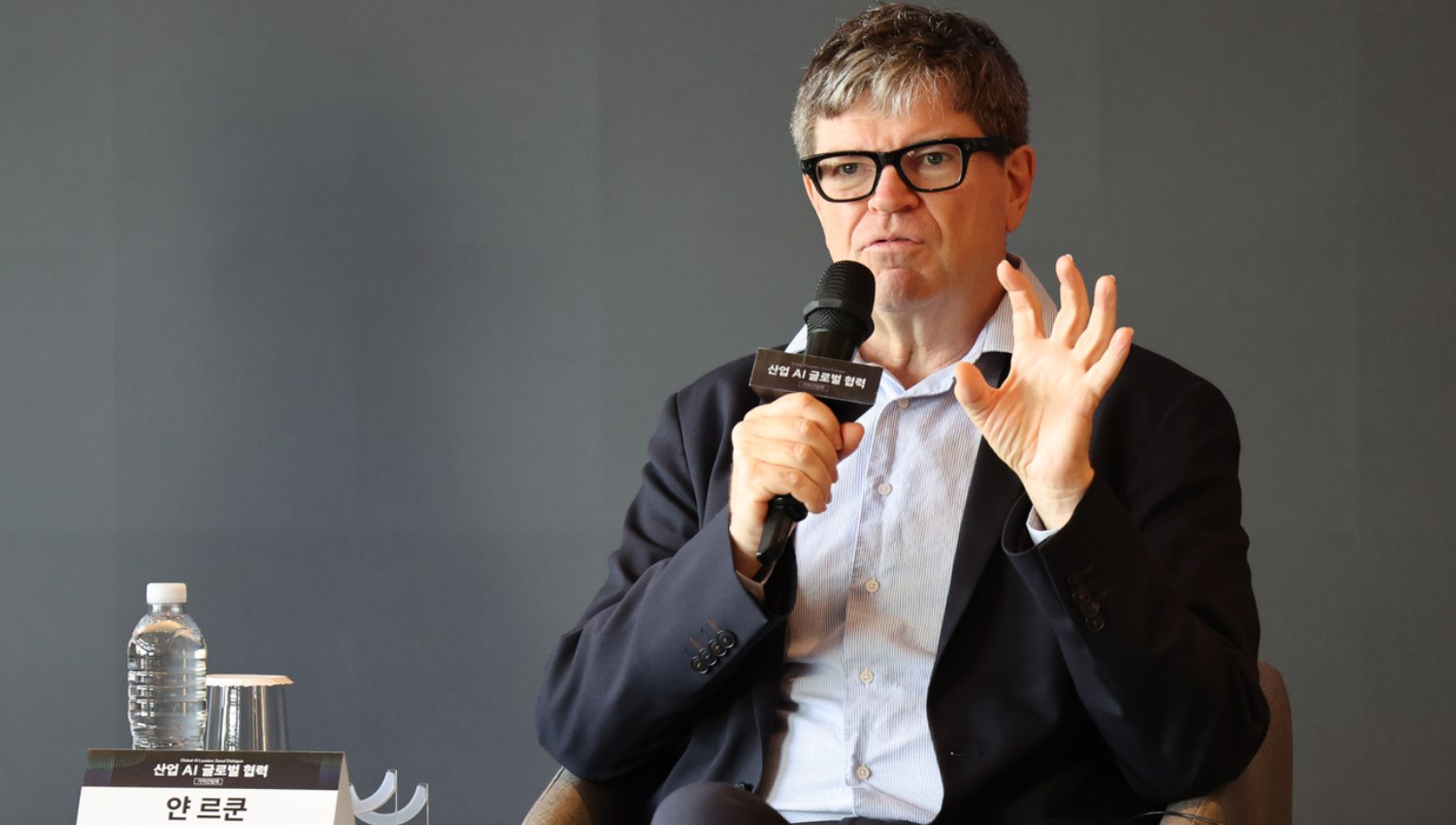

Yann LeCun, the 2018 Turing Award winner who founded and chairs AMI Labs, told an industrial AI briefing in Seoul on Monday 12 October that the next leap in AI will come from systems that can understand, predict and act in the physical world rather than from ever larger language models. He said that shift could give South Korea, with its strength in manufacturing, robotics and engineering, a real opening.
LeCun calls these systems world models: software that predicts how the physical world changes in response to an action and can plan a series of steps towards a goal, rather than guessing the next word. Current models capture knowledge from text, images and video, he said, but do not reliably grasp cause and effect. AI can prove maths theorems and pass professional exams, yet robots still struggle with household chores a 10-year-old manages without training. AMI Labs is building its approach on a joint-embedding predictive architecture.
The panel, organised by Aitomatic and the IIAC 2026 committee ahead of the fifth International Industrial AI Conference in Tokyo the following day, urged Korea not to try to match US spending on AI infrastructure and instead to put AI to work quickly in factories, ships and machinery.
Aitomatic chief executive Christopher Nguyen said the country should deploy industrial AI “early and often” while tightening security and governance. LeCun called for Korea to attract global research talent and to shorten the path from basic research to commercial products. ASI Foundry chairman Jimmy Rhee described Korea’s industrial data as a strategic resource and warned against waiting for perfect information.
Ha Jung-woo, vice chairman of the National AI Strategy Committee, said competition is moving from model performance to industrial productivity and named semiconductors, cars, shipbuilding and batteries as Korean strengths. AI Alliance co-chair Anthony Annunziata pointed to Project Tapestry, in which members develop an open foundation model together while keeping control of their own data.
LeCun also rejected the idea that recent AI-related attacks on Korea’s financial sector show the technology slipping out of control. He blamed weak safeguards and leaky sandboxes around the software. “The companies deploying the agents lacked sufficient security expertise,” he said. Today’s models can be jailbroken and are hard to constrain through fine-tuning alone, he noted, but future objective-driven systems could check guardrails before acting, and he argued AI may end up helping defenders, who have more resources and share more openly.