
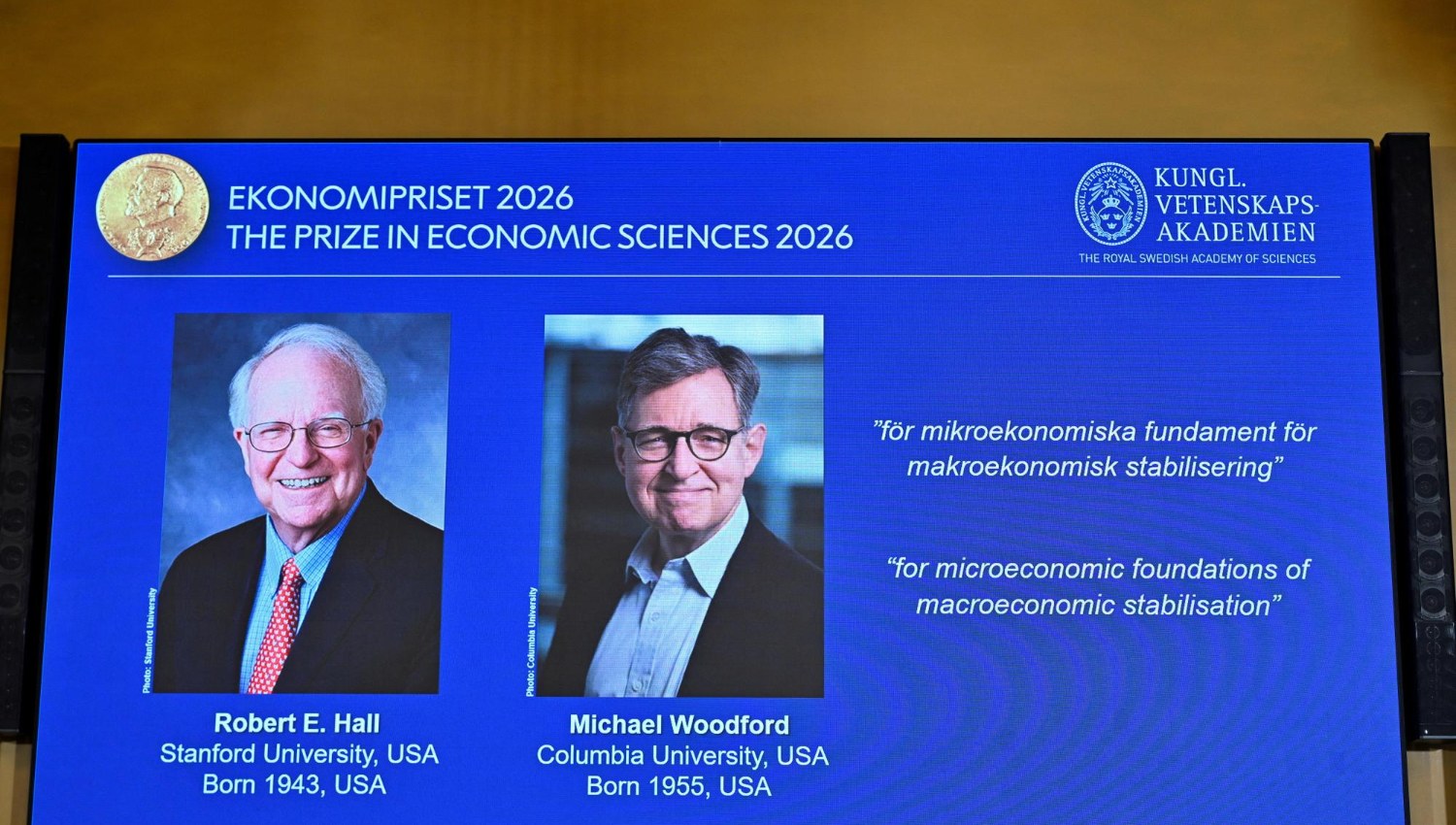

American economists Robert E Hall and Michael Woodford have won this year’s Nobel memorial prize in economics for their work on the microeconomic foundations of macroeconomic stabilisation. Both men were born in the United States. The Royal Swedish Academy of Sciences announced the award in Stockholm on Monday, a week after the other Nobel prizes were named.
Hall, 83, is a professor at Stanford University in California, and Woodford, 71, is a professor at Columbia University in New York. John Hassler, who chairs the Committee for the Prize in Economic Sciences, said their research gives central banks and governments a stable theoretical basis for the models they use. He said that helps policymakers respond to shocks such as energy crises or sudden changes in household spending.
Speaking to journalists in Stockholm by telephone from the United States, Woodford said the award was a surprise, that he felt elated and that it was a tremendous honour. He said traditional monetary policy tools had not been enough during the 2008 financial crisis, when interest rates in many countries had already been cut to zero. Central banks then began giving more explicit signals about where they expected rates to go, a practice that continues today. Woodford said the approach contributed to better stabilisation, but added that “it didn’t magically solve the problem”.
The award’s formal name is the Bank of Sweden Prize in Economic Sciences in Memory of Alfred Nobel.
Sweden’s central bank created it in 1968, so it was not one of the five prizes founded by Nobel, the 19th-century Swedish chemist and businessman who invented dynamite, and purists argue it is technically not a Nobel prize at all. It is presented with the other prizes on 10 December, the anniversary of Nobel’s death in 1896. This year’s prize is worth 12 million Swedish kronor, which the two laureates will share equally. Under the rules, the money can go to an individual, a small group or an organisation.
Most winners of the economics prize have come from the United States, and only three women have received it, most recently Claudia Goldin in 2023 for research on how gender has shaped pay and employment in the US. Last year’s prize went to three researchers who studied how new products and inventions drive economic growth. The prizes for medicine, physics, chemistry, literature and peace were announced the previous week, and all will be presented in December.