


Ask what a luxury watch costs to make and the industry changes the subject. The steel is cheap. The movement, in most cases, comes from a supplier. The premium sits in the name on the dial, the boutique on the good street, and a century of advertising the buyer is quietly asked to refund. Devin Mercier built a watch company on the assumption that plenty of people have done that arithmetic and resented the answer.
Mercier Prototype, the brand Mercier founded and runs as its sole designer, ships its first automatic today. The Manx sells for $795. It arrives in a market where the biggest players have spent two years proving that they no longer want customers at that price.
The Federation of the Swiss Watch Industry reported in January that exports fell 1.7% to CHF 25.6 billion in 2025, the second consecutive annual decline, while unit volumes dropped 4.8% to 14.6 million, the lowest in decades. The weakest band was the cheapest one. Watches exported at under CHF 500 fell 4.5%. Meanwhile, according to the ninth Morgan Stanley and LuxeConsult Swiss Watcher report published in February, watches priced above CHF 50,000 made up 1.4% of volume in 2025 and 89% of the industry’s value growth. Four privately held brands, Rolex, Patek Philippe, Audemars Piguet and Richard Mille, now account for 49.1% of the market by value. Swatch Group has publicly disputed parts of that report’s brand-level estimates, but nobody disputes the direction. The Swiss are not losing the bottom of the market. They are leaving it.
The spec sheet is the argument
Mercier’s operating principle is what the brand calls radical spec honesty. Name the movement. Publish the numbers. Let the object justify the price.
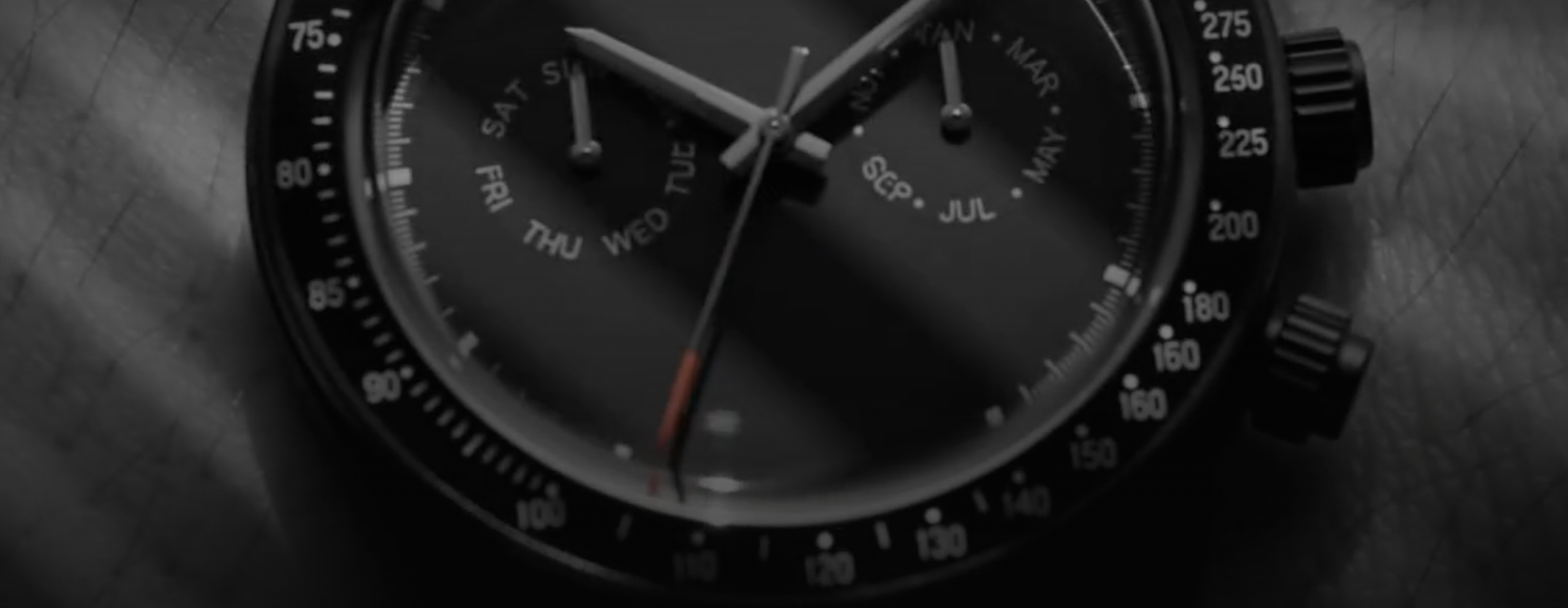
So the numbers are published. The Manx runs a Japan-made Miyota Cal. 9122 automatic with a roughly 42-hour power reserve, visible through an exhibition caseback. The 42mm case is 316L stainless steel finished in black PVD. The crystal is domed sapphire. Water resistance is rated to 10 ATM. It carries date, day and month complications and a single line of racing red. Nothing on that list is a secret, which is the point. Miyota, owned by Citizen, produces roughly 100 million movements a year according to trade publication Europastar, and its automatic calibers sit inside a large share of the world’s independent watch brands. Mercier is not claiming a movement nobody else has. He is claiming he will tell you exactly what you are buying.
That is a sharper position than it sounds, because the luxury end of the market runs on the opposite instinct. Richemont, owner of Cartier, IWC and Vacheron Constantin, reported a group gross margin of 66.9% for the year to March 2025. Rolex raised US prices by an average of about 7% on January 1, 2026, according to WatchPro, after two increases in 2025 that left American retail prices roughly 15% higher than a year earlier. Currency, gold and tariffs explain part of that. They do not explain all of it. When two thirds of the retail price is gross margin before a single ad is bought, a buyer with a spec sheet open on a second screen starts asking uncomfortable questions.
Five years is a number the big houses already conceded
The ownership terms extend the same logic. Every Manx is individually numbered. The warranty runs five years. The return window is 30 days, long enough to wear the watch rather than audition it.
“Every Mercier is designed by me, individually numbered, and backed by me,” Mercier says, adding that if a piece is not right, the buyer should send it back.
The industry standard warranty is two years, the minimum required under European law. Rolex moved to five years in 2015 and Omega followed in 2018, a shift Forbes described at the time as three years beyond the norm. Mercier is offering the Rolex warranty on a watch that costs less than the sales tax on a Rolex. He is also offering it as a one-man operation, which makes the promise personal in a way a service department cannot be, and fragile in a way a service department is not.
Accessibility is handled without embarrassment. The $795 splits into four instalments of roughly $199 at checkout, a structure that luxury brands historically treated as beneath them. Adobe counted $20 billion in US online buy-now-pay-later spending across the 2025 holiday season, up 9.8% on the year. Mercier treats the instalment plan as arithmetic rather than a concession.
The buyer has already moved
Deloitte’s 2025 Swiss watch industry study surveyed 6,500 consumers and 111 executives. Forty percent of Gen Z and millennial respondents said they intend to buy a pre-owned watch in the next twelve months, twice the rate among Baby Boomers. Executives in the same study named independent brands the number one coming trend, ahead of artificial intelligence. Both figures describe the same person: younger, comparison-shopping, unmoved by the boutique, and open to a name they had not heard of last year.
A fair reader should hold some doubt. Every microbrand publishes its movement, so spec honesty is less a moat than a table stake dressed as a philosophy. The Miyota 9122 is available to any brand with a purchase order. PVD coatings wear at the edges over years of daily use. A 42mm black case in two dial colors is a narrow first offering, and Mercier has disclosed no production numbers, no sales figures and no plan for what happens to a five-year warranty if the one man behind it steps away. The first run ships today. Nothing about its reception is yet known.
What is known is the shape of the gap. The affordable watch is supposed to be disposable and the luxury watch is supposed to be untouchable. The Manx is engineered like neither: sapphire, steel and 10 ATM say daily wear, while the serial number and the five-year promise say permanence. Luxury, on Mercier’s reading, is not the markup. It is the confidence that the thing on your wrist was made by someone who will answer for it.
The heritage houses will not notice a one-man brand from the accessible end of the market. Their customers, comparing spec sheets late at night, might.